Now this is just plain COOL Alaskan cycling...
Mark's Channel on YouTube
Bill and Kathi's YouTube Channel
-
Feb 10, 2009


Jan 27, 2009
Winter Foot System

A - Liner sock, Generic Polyester Mens Dress Sock
B - VBL Sock, RBH, Single Layer (top)/Insulated (bottom(insideout))
C - Insulation Sock, RBH VBL Combo (top)/Hollowfill Wool(bottom)
D - Boot, Solomon B52 TS GTX (top)/Insulated Footbeds(bottom)
E - Gaiters, Outdoor Research, Epic Fabric
F - Overboot Insulated, Wiggys
G - Overflow Overboot, Wiggys
Tony,
I think I have about the same $ invested in my footsystem...I guess you get what you pay for in footgear. You could probably (lol, I know you can) go 2 the second-hand store and pickup a pair of old softsole sorels and then head-over to the food store and clip a dozen fruit/vegetable plastic bags for vbls, slap a good gaiter on them...and get pretty good results too...for way way less!
Really liking the idea of layering on the feet, just like we do with our other clothing systems, because it adds to the variability... the real trick is accommodating all conditions...on expeditions and esp. here in the Delta I'm forced to work across the gamut of conditions...thus, the layered, interchangeable, foot system.
I gotta say...
the Wiggys overflow waders, at 8oz, tiny packsize and fitting over all my gear...I don't leave home without them...life saver here! If we were to have a race here on the Kusko I would make them mandatory gear.
the Wiggys Lamilite insulated boots are way way warm....preliminary look is good but the verdict is still out on how far you can walk in them though...will know more after spring expeditioning.
RBH vbls are way superior to anything else I've used...insulated version is rightup there with any other sock combination I've used.
the Solomons are IT for me...super light for a winter boot, plenty warm just the right amt. thinsulate (I think 400gm), just the right flex in the sole which doesn't freeze and most important, the fit for for my wide foot is perfect...I'm using them @ 2 sizes-oversized. A real winter hiking boot...the only mods I made were that I nailed some sheet metal screws to the sole for traction and put some longer laces on them.
using men's dress socks is not only 'style'ish' they are the only liner socks I've ever worn that actually 'stays up' and doesn't sink into a ball under my foot...thats good!
Links on MTBR et al:
Insulating Feet from Pedals?
Lobbens, NEOS or both?
Winter Shoes The Warmest?
Winter Riding and Warm Feet
Winter Boot Setup
__
Dec 23, 2008
Derailleurless Multispeed
DMS
Derailleurless Multi-Speed
[Overview: Expedition style drivetrain; primary winter riding - remote frozen river trail and beach coastal evirons; purpose - simplicity and variability, minimalist but not without; builder - Martin Leonard III]
Surly Pugsley Framset
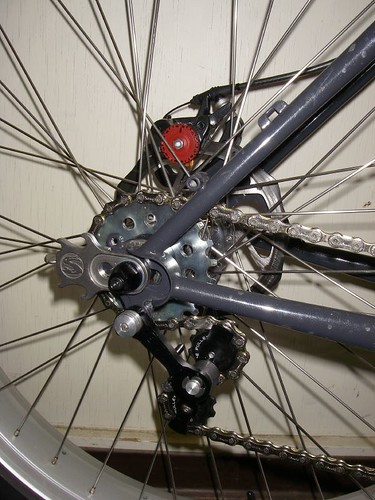
Phil Cassette Hub
Paul Tensioner
Surly SS Cog / 22t
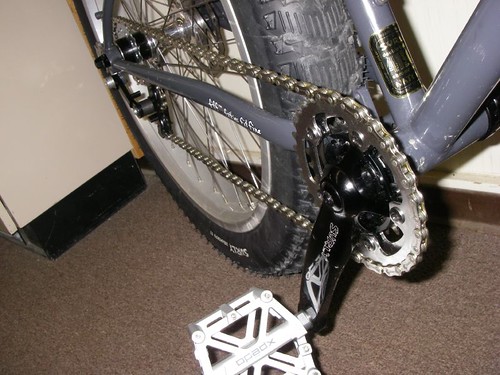
Surly Whirly Crankset
Surly and Salsa Rings
22t / 30t / 33t
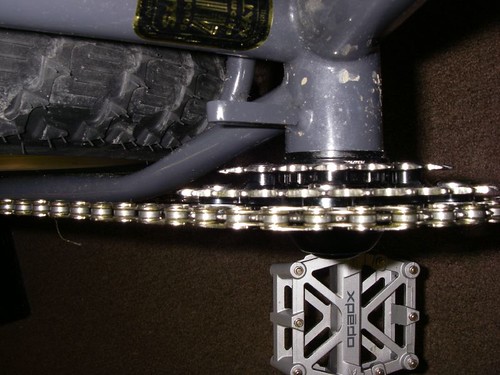
3 Speed Manual Transmission...Simple
Two Main Gear Ratios: 39.5 / 43.5 gearinches
Bailout Gear Ratio: 29.0 gearinches
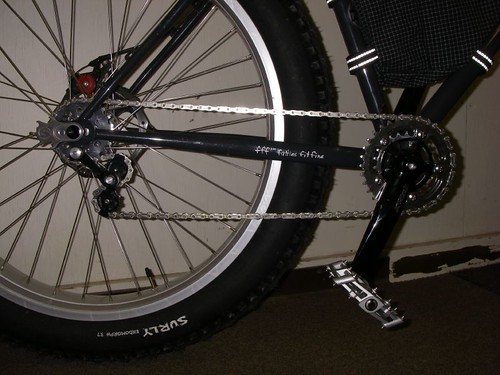
And if you're really good...you can shift with a flick of the toe!
_
Derailleurless Multi-Speed
[Overview: Expedition style drivetrain; primary winter riding - remote frozen river trail and beach coastal evirons; purpose - simplicity and variability, minimalist but not without; builder - Martin Leonard III]
Surly Pugsley Framset
Phil Cassette Hub
Paul Tensioner
Surly SS Cog / 22t
Surly Whirly Crankset
Surly and Salsa Rings
22t / 30t / 33t
3 Speed Manual Transmission...Simple
Two Main Gear Ratios: 39.5 / 43.5 gearinches
Bailout Gear Ratio: 29.0 gearinches
And if you're really good...you can shift with a flick of the toe!
_
Nov 22, 2008
A Thin White Line

On February 24, 2001, more than one hundred adventure racers from over ten nations embarked on three of the hardest adventure races in the world: The Iditasport 130, Iditasport Extreme & Iditasport Impossible.
A Thin White Line follows this 1,100 mile race along the Iditarod Trail from Knik Lake to the historical gold rush town of Nome in some of Alaska’s harshest back-country.
Explore the bitter cold and bitter sweet trials and tribulations in this award-winning, adventure documentary, now available on DVD.
http://www.athinwhiteline.com/AThinWhiteLine/Home.html
.
Oct 13, 2008
Lost Coast Expedtion
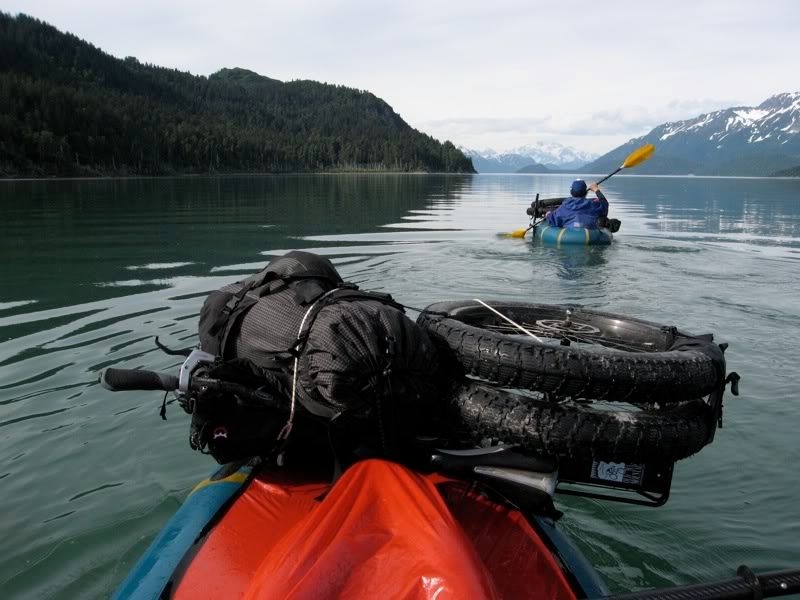 http://lostcoastbike.blogspot.com/
The Lost Coast is a stretch of wild coastline along the Gulf of Alaska starting from the eastern end of Prince William sound extending some 400+ miles to the south and east. Bordered on one side by thousands of miles of open ocean and breaking waves and the high glacier covered Chugash and St. Elias Mountain ranges on the other. It is not protected by islands and is fully exposed to the brunt of the sea and weather systems that swirl in the gulf building power, then slam into the mountains to the north. With that said, it is a incredibly beautiful and wild stretch of coastline.
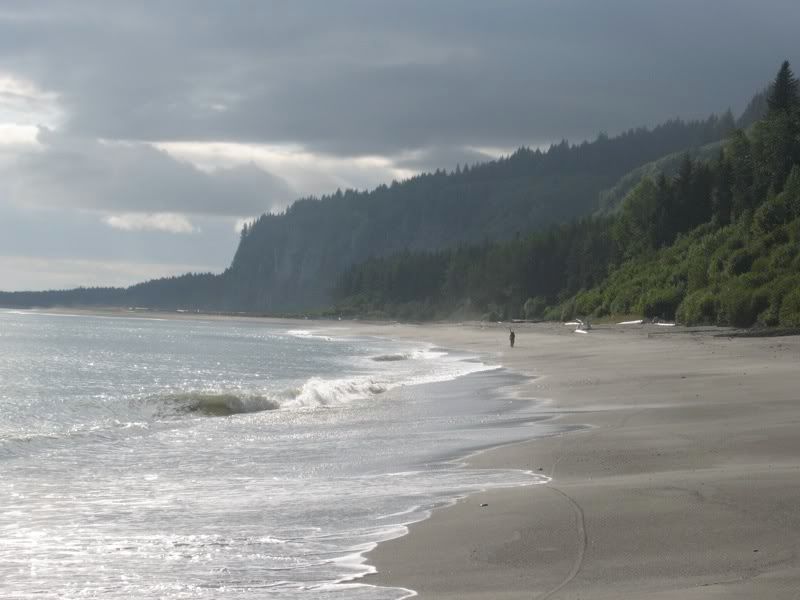 Starting on August 18th, we will attempt to make the journey between the towns of Yakutat and Cordova. Biking the beach when we can, foot when we can't and use packrafts to cross the large bays and portage the numerous glacier fed rivers. Our route is front loaded with challenges. Close to Yakutat we will need to cross the Hubbard Gap - a massive calving tidewater glacier bordered by steep & rocky shoreline. Heading North we encounter the Sitkagi Bluffs and the worlds largest piedomont glacier, the Malaspina. Next up is perhaps the biggest challenge of Icy Bay. A 3 mile crossing of a bay chock full of icebergs. Continuing northward is cape Yakataga, the mid-way point and food drop that will be delivered by a bush pilot.
Lost Coast Trailer from Eric Parsons on Vimeo.
Miles of beach later we reach the barrier islands and the beginning of the massive Copper River Delta which we must finally stumble across to reach to town of Cordova about 300 miles of wilderness from where we started. Fun!
http://lostcoastbike.blogspot.com/
May 31, 2008
Kuskokwim River Fatbike UPRIVER
Bjorn and Martin on the upper Kuskokwim River, Alaska
Watch the Videos here:
Part 1
Part 2
Watch the Videos here:
Part 1
Part 2
Dec 16, 2007
Rabbit Gear Calculator
Tom Kunicki has a calculator with specific features useful for fixed-gear and singlespeed riders; fast and convenient:
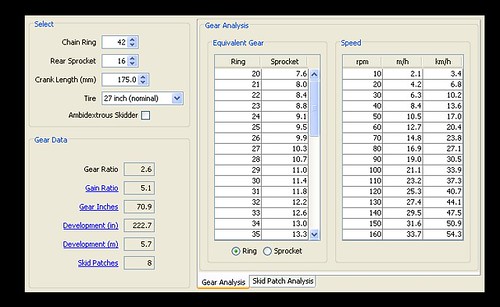
Link to the front page of the Rabbit calculator
http://software.bareknucklebrigade.com/
The Standard - Sheldon Brown's gear calculator:
http://www.sheldonbrown.com/gears/
___________
SS Gearing Discussion:
http://forums.mtbr.com/showthread.php?t=471175
Find the Magic Number for Snowbiking Fatbikes:
http://forums.mtbr.com/showthread.php?t=265028&highlight=winter+ss+gear
.
Link to the front page of the Rabbit calculator
http://software.bareknucklebrigade.com/
The Standard - Sheldon Brown's gear calculator:
http://www.sheldonbrown.com/gears/
___________
SS Gearing Discussion:
http://forums.mtbr.com/showthread.php?t=471175
Find the Magic Number for Snowbiking Fatbikes:
http://forums.mtbr.com/showthread.php?t=265028&highlight=winter+ss+gear
.
Dec 12, 2007
SnowBiking History
Well...not exactly Fatbikes
But the precursor...some great footage of winter biking in 'the early days' here in Alaska. Images from the second running of the Iditabike race.
Part 1
Part 2
Part 3
This is the story of The Iditabike 1988 race in Alaska on the Iditarod Trail...Originally broadcast on the Discovery Channel
©1988-2007 Mark Forman Productions, Corp.
Further discussions regarding the film on mtbr forum here!
ml
But the precursor...some great footage of winter biking in 'the early days' here in Alaska. Images from the second running of the Iditabike race.
Part 1
Part 2
Part 3
This is the story of The Iditabike 1988 race in Alaska on the Iditarod Trail...Originally broadcast on the Discovery Channel
©1988-2007 Mark Forman Productions, Corp.
Further discussions regarding the film on mtbr forum here!
ml
Nov 29, 2007
Epic Designs

Custom and speciality outdoor gear made and tested in Alaska.
Its my passion to design gear and build gear to help you pursue your passions, whether they be cycling insanely long distances, climbing and skiing hard new lines, or packrafting first descents in the Arctic. All work is garanteed bombproof with a 100% satisfaction garantee.
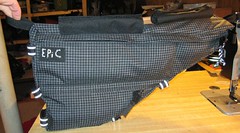
http://www.epicdesignsalaska.com/
Top 10 Tips for Biking in Snow
Originally posted at NPR.org, December 14, 2007
Jill Homer of Juneau, Alaska, is training to ride 350 miles in the human-powered Iditarod. The race, which starts in February, follows the same route used by the famous dog sled teams.
People sometimes say, "Wow, riding a bike on snow — that's great. But how does it work?" Snow-biking can be different from regular cycling, so I've compiled a list of 10 tips for riding a bike on snow.
1. Think surface area: If you've ever used snowshoes before, you know that all that mass at the bottom of your feet can mean the difference between coasting atop power or wading knee-deep in it. Snow bikes work they same way. They incorporate wide tires with a flat profile in order to distribute bulk (you) as evenly as possible, allowing for maximum floatation.
2. Fat is the new skinny. As long as there have been bicycles, there have been weight-weenie types trying to shave grams off wheels. Nowadays, it's not uncommon to see a spoke-free wheel sporting tires as thin as razors. But once you slice into snow, skinny tires might as well be razors. Snow-bikers know that fat means float, and have been developing bicycles to accommodate increasingly larger wheels for years. I predict that not too far in the future, someone will build a bicycle frame with room for motocross tires. Look for it.
3. There is no shame in walking. Cyclists hate to admit when they come to a hill or an obstacle they just can't conquer. I have seen cyclists blow out their knees and face-plant over logs just to avoid suffering the indignity of getting off the bike and walking. Snow-bikers have no such pretensions. We know that bikes are not ready-made for snow, and vice versa. If snow is too soft, or too deep, or too wet, we simply step off and amble along until we can ride again. We learn to enjoy it, like walking a dog, but without the constant slobbering.
4. When in doubt, let air out. Often, snowy trails are what we would call "marginally ridable." By letting air out of tires, you can increase the surface area and improve your floatation. Sometimes it means riding on nearly flat tires at a pace a snail wouldn't envy, but, despite what I said in the previous paragraph, it's still better than walking.
5. Learn your snow types. It's been said that Eskimos have dozens of different words of snow. Snow bikers also understand the myriad varieties: powder, sugar, corn, hard-pack, sandy, slushy, and so on. Each type comes with its own challenges. But understanding the nature of the white stuff you are trying to ride atop, you can adjust your riding and wheels to meet the conditions.
6. Don't be disappointed when you fail to set a land-speed record. Snow, like sand, puts up a lot of resistance, and snow bikers are not known for their speed. I have often heard accounts of cyclists who said felt like they were careening down a hill, only to look down and see they hadn't even breached the 10 mph barrier. In snow races, 10 mph is considered fast. Eight mph is average. Six mph is respectable, and four mph isn't uncommon. When asked to describe the nature of the 2006 Iditarod Invitational, which was plagued by cold temperatures and fresh snow, third-place finisher Jeff Oatley said, "It was about as intense as a 2.5 mph race can be."
7. All brakes are not created equal. When contemplating what brakes to put on their bikes, cyclists have all kinds of reasons to choose between disc or rim. But snow bikers, who often find their rims coated in a thick layer of ungrippable ice, have the best reason of all: Rim brakes could mean an icy death by gravity. Go with disc.
8. Re-lubricate and be free. There is nothing that will slow down a snow biker faster than having their hubs freeze up, which is always a possibility when the mercury drops below zero. We have to lube up our moving parts with a special low-temperature grease, sold widely in cold regions like Fairbanks and Minnesota.
9. Stay away from moose tracks. Common injures for road cyclists include road rash and head injuries. Mountain bikers have problems with broken collar bones and bad knees. Alaska snow bikers are always being tripped up by the deep, narrow holes moose leave when they walk through the snow. Avoiding these minefields will help curb post-holing injuries like broken ankles.
10. Stay away from dogs. We talk a lot about fear of angry moose, grumpy bears and rabid wolves, but our most likely animal to have a dangerous encounter with remains the sled dog. They approach so quickly and quietly that we sometimes don't even have time to jump off the trail. A collision can be disastrous — imagine tangled lines, confused canines and a lot of sharp teeth. Add to that an annoyed musher who's likely packing heat, and you stir up the kind of fear that convinces snow-bikers to give those racing puppies a wide berth.
Jill Homer blogs at Up in Alaska.
Jill Homer of Juneau, Alaska, is training to ride 350 miles in the human-powered Iditarod. The race, which starts in February, follows the same route used by the famous dog sled teams.
People sometimes say, "Wow, riding a bike on snow — that's great. But how does it work?" Snow-biking can be different from regular cycling, so I've compiled a list of 10 tips for riding a bike on snow.
1. Think surface area: If you've ever used snowshoes before, you know that all that mass at the bottom of your feet can mean the difference between coasting atop power or wading knee-deep in it. Snow bikes work they same way. They incorporate wide tires with a flat profile in order to distribute bulk (you) as evenly as possible, allowing for maximum floatation.
2. Fat is the new skinny. As long as there have been bicycles, there have been weight-weenie types trying to shave grams off wheels. Nowadays, it's not uncommon to see a spoke-free wheel sporting tires as thin as razors. But once you slice into snow, skinny tires might as well be razors. Snow-bikers know that fat means float, and have been developing bicycles to accommodate increasingly larger wheels for years. I predict that not too far in the future, someone will build a bicycle frame with room for motocross tires. Look for it.
3. There is no shame in walking. Cyclists hate to admit when they come to a hill or an obstacle they just can't conquer. I have seen cyclists blow out their knees and face-plant over logs just to avoid suffering the indignity of getting off the bike and walking. Snow-bikers have no such pretensions. We know that bikes are not ready-made for snow, and vice versa. If snow is too soft, or too deep, or too wet, we simply step off and amble along until we can ride again. We learn to enjoy it, like walking a dog, but without the constant slobbering.
4. When in doubt, let air out. Often, snowy trails are what we would call "marginally ridable." By letting air out of tires, you can increase the surface area and improve your floatation. Sometimes it means riding on nearly flat tires at a pace a snail wouldn't envy, but, despite what I said in the previous paragraph, it's still better than walking.
5. Learn your snow types. It's been said that Eskimos have dozens of different words of snow. Snow bikers also understand the myriad varieties: powder, sugar, corn, hard-pack, sandy, slushy, and so on. Each type comes with its own challenges. But understanding the nature of the white stuff you are trying to ride atop, you can adjust your riding and wheels to meet the conditions.
6. Don't be disappointed when you fail to set a land-speed record. Snow, like sand, puts up a lot of resistance, and snow bikers are not known for their speed. I have often heard accounts of cyclists who said felt like they were careening down a hill, only to look down and see they hadn't even breached the 10 mph barrier. In snow races, 10 mph is considered fast. Eight mph is average. Six mph is respectable, and four mph isn't uncommon. When asked to describe the nature of the 2006 Iditarod Invitational, which was plagued by cold temperatures and fresh snow, third-place finisher Jeff Oatley said, "It was about as intense as a 2.5 mph race can be."
7. All brakes are not created equal. When contemplating what brakes to put on their bikes, cyclists have all kinds of reasons to choose between disc or rim. But snow bikers, who often find their rims coated in a thick layer of ungrippable ice, have the best reason of all: Rim brakes could mean an icy death by gravity. Go with disc.
8. Re-lubricate and be free. There is nothing that will slow down a snow biker faster than having their hubs freeze up, which is always a possibility when the mercury drops below zero. We have to lube up our moving parts with a special low-temperature grease, sold widely in cold regions like Fairbanks and Minnesota.
9. Stay away from moose tracks. Common injures for road cyclists include road rash and head injuries. Mountain bikers have problems with broken collar bones and bad knees. Alaska snow bikers are always being tripped up by the deep, narrow holes moose leave when they walk through the snow. Avoiding these minefields will help curb post-holing injuries like broken ankles.
10. Stay away from dogs. We talk a lot about fear of angry moose, grumpy bears and rabid wolves, but our most likely animal to have a dangerous encounter with remains the sled dog. They approach so quickly and quietly that we sometimes don't even have time to jump off the trail. A collision can be disastrous — imagine tangled lines, confused canines and a lot of sharp teeth. Add to that an annoyed musher who's likely packing heat, and you stir up the kind of fear that convinces snow-bikers to give those racing puppies a wide berth.
Jill Homer blogs at Up in Alaska.
Nov 25, 2007
Grease Guarding Surly New Hub
We like the Surly new hubs...they are simple, fairly well made, cost effective and with lots of layup options.
Have built up a number of wheelsets for winter fatbikes using the Surly hubs (w/ Large Marge rims as well as Speedway 70s and 100s). Out of the box and prior to use, we're upgrading the hub with 1) Phil Wood Spec'd bearings and 2) Morningstar Soup / Grease for winter conditions. On a recent rebuild we took it a step further by modifying the hubs and making them grease-able in situ.
Quick, fyi, description: Break the hub down as usual. Prior to reinstall of the bearings we drill a small thru-hole in the body of the hub. The hole is tappered and located dead center on the hub body. Its easier to do this before the wheels are laced-up. Important to clean all shavings and metal filings from the hub; esp the axle cavity. We just black tape the hub to cover the hole.
We remove the seals on each Phil cassette bearing and clean with a good degreaser and repack with Paul Morningstar's Soup. Replace ONLY the outboard seal on the bearing
The hub is then reassembled.
Before adjusting and tightening the endcap, with a small greasegun you can now inject more Morningstar Soup into the center of the hub body. Once the cavity is filled (doesn't take much as the axle fills most of the body void) force / pressure will move grease down through the hub, across the bearings and out the outboard seals...purging the bearing of any unwanteds while refreshing the grease.
Works well on the Surly Hubs. Same concept is applied to Phil Bottom brackets and the platform pedals we use!
[Grease Gurard is a TradeMark of WTB...we DO use some legacy WTB GG hubs, all our bikes have WTB GG headsets and some riders are using the WTB GG pedals]
Martin
Have built up a number of wheelsets for winter fatbikes using the Surly hubs (w/ Large Marge rims as well as Speedway 70s and 100s). Out of the box and prior to use, we're upgrading the hub with 1) Phil Wood Spec'd bearings and 2) Morningstar Soup / Grease for winter conditions. On a recent rebuild we took it a step further by modifying the hubs and making them grease-able in situ.
Quick, fyi, description: Break the hub down as usual. Prior to reinstall of the bearings we drill a small thru-hole in the body of the hub. The hole is tappered and located dead center on the hub body. Its easier to do this before the wheels are laced-up. Important to clean all shavings and metal filings from the hub; esp the axle cavity. We just black tape the hub to cover the hole.
We remove the seals on each Phil cassette bearing and clean with a good degreaser and repack with Paul Morningstar's Soup. Replace ONLY the outboard seal on the bearing
The hub is then reassembled.
Before adjusting and tightening the endcap, with a small greasegun you can now inject more Morningstar Soup into the center of the hub body. Once the cavity is filled (doesn't take much as the axle fills most of the body void) force / pressure will move grease down through the hub, across the bearings and out the outboard seals...purging the bearing of any unwanteds while refreshing the grease.
Works well on the Surly Hubs. Same concept is applied to Phil Bottom brackets and the platform pedals we use!
[Grease Gurard is a TradeMark of WTB...we DO use some legacy WTB GG hubs, all our bikes have WTB GG headsets and some riders are using the WTB GG pedals]
Martin
Nov 23, 2007
FatBack Ti Frameset
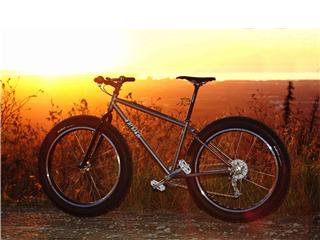
Fatback Titanium Frame from Speedway Bicycles.
link to Speedway Cycles, Anchorage, Alaska
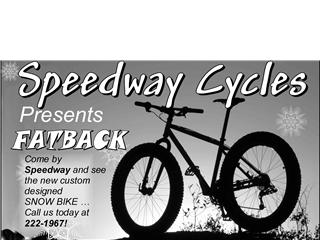
Another fine Alaskan Product...the guys and gals at Speedway are on top of the art of Fatbiking in Alaska...lots of fine products in their shop and a lot of knowhow to go along with it.
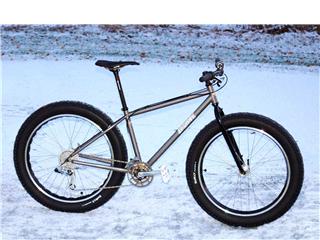
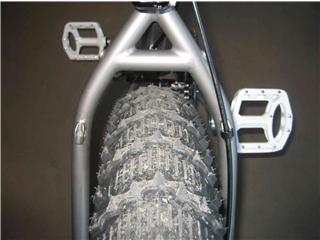
It has mondo clearance, vertical droputs, 100mm width fork, (other fork options and widths available,) 100mm bb so you have all possible gears. Plenty of standover in all sizes, and best of all it's ti. It's the perfect material for a snowbike-light (3.3 for a 16, 3.5 for an 18, and 3.65 on a 20) and rust free.
Read the MTBR thread for more info:
http://forums.mtbr.com/showthread.php?t=348857
link to Speedway Cycles, Anchorage, Alaska
Another fine Alaskan Product...the guys and gals at Speedway are on top of the art of Fatbiking in Alaska...lots of fine products in their shop and a lot of knowhow to go along with it.
It has mondo clearance, vertical droputs, 100mm width fork, (other fork options and widths available,) 100mm bb so you have all possible gears. Plenty of standover in all sizes, and best of all it's ti. It's the perfect material for a snowbike-light (3.3 for a 16, 3.5 for an 18, and 3.65 on a 20) and rust free.
Read the MTBR thread for more info:
http://forums.mtbr.com/showthread.php?t=348857
Subscribe to:
Posts (Atom)